Posts Tagged patient-centered care
When it really is a virus
Posted by Nick Bennett MD in Bacteria, EBM, Infections on November 30, 2012
I joke that, as a Peds ID doc, it is my duty to say this at least once a day…
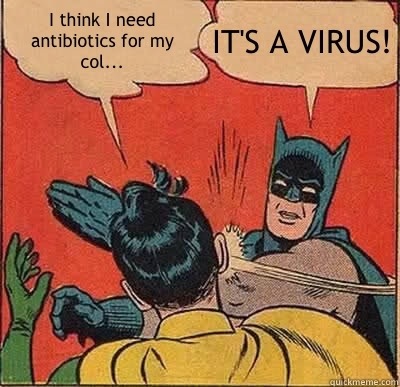
Ok, I may not literally be slapping people upside the head, but there are certainly times when I’m doing it in my mind. The situation is common enough – a patient, parent or doctor, faced with symptoms consistent with an infectious disease, considers using antibiotics to treat bacteria. After all, we know that bacteria kill people, right? But in many of these situations the patient really has a viral infection – and viruses aren’t affected by antibiotics. So at the very least we’re wasting money and drugs. Worst case scenario? We’re promoting drug-resistant bacteria, antibiotic allergies and side effects – that in some cases can be life-threatening.
But aren’t there clues to help us make the distinction? Real clinical signs and symptoms? Well, lets review a few.
White pus on the tonsils
Everyone is familiar with the feeling of an awful sore throat, and having a doctor peer down and having you say “Ahhhh…” What are they looking for. Probably something like this:
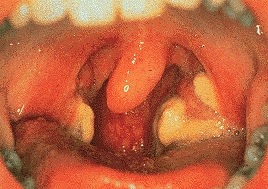
This is a classic appearance of “Strep Throat” – a bacterial infection that aside from being painful in its own right can go on to lead to serious complications, such as rheumatic heart disease, kidney disease, a form of arthritis and a weird neurologic disorder called “Sydenham’s Chorea”. Fortunately it has no drug resistance so simple penicillin/amoxicillin will kill it (so if your doc tries to give you “stronger” antibiotics please feel free to slap them).
The trouble is, this isn’t a picture of strep throat. I grabbed this from an article on “Mono”. Infectious Mononucleosis can be indistinguishable from strep throat, but antibiotics do nothing for it. The “pus” you see isn’t really pus, it’s just a nasty-looking white gunk your tonsils make. A bad sore throat can be caused by influenza, adenovirus, RSV, metapneumovirus, rhinovirus….you get the idea. It can be hard to tell strep throat from any of the other many possibilities, but in general if you DON’T have a runny nose or a cough, and the lymph nodes in your neck hurt then it’s PROBABLY strep. But it could be a virus. Strep tests and cultures help – and holding off on treatment until the test comes back is a sensible plan.
Red eardrums
What about ear infections? Another common bane of pediatrics (almost every young child I see with a prolonged illness has at some point been diagnosed with an “ear infection” before arriving at the correct diagnosis – I once saw a kid with a brain tumor get that diagnosis…). The symptoms are notoriously non-specific (ear pulling, fussiness, fever) and a good ear exam in a small, squirming child can be difficult! A crying baby can turn their ear drums pink…and voila! An ear infection! But even assuming your exam is good and the ear drum really does look nasty, how do we know its a bacterial infection? Despite the appearance of a rip-roaring otitis media (bright red, bulging ear drum, fluid behind it) it can be a viral infection too. Most of what you see is the BODY’S response to the infection remember. Clinical trials of antibiotic use have shown with without antibiotics, ear infections tend to get better just as quickly as with them. Complications from untreated bacterial infections do exist, and can be quite serious, but are rare. It is prudent to consider a “wait and see” approach to ear infections to see if it gets better by itself. I don’t want your kid to get mastoiditis any more than you do, but if it does happen I want it to be treatable with the best antibiotics!
Most of the time when we’re treating ear infections we’re not even treating the child…we’re allowing the adults in the house to get a good nights sleep…;-)
Cough, fever, patches on chest x-ray
Pneumonia? Guess what. Usually a virus, at least in kids, before they become immune to everything. Without proper testing though this can be harder to tell apart, and we’re getting into the realm of “sick kid” here. Almost every doc will feel a little weird ignoring a possible bacterial pneumonia, even if they really do think its viral. But the high rate of viral infections, along with the risk of increasing drug resistance, is why the current recommendations for antibiotic treatment of pneumonia in children start with plain old amoxicillin. RSV, metapneumovirus, influenza, adenovirus – they can all cause pneumonia. In the Bad Old Days viruses like measles and varicella could also do it, and they were quite nasty! With symptoms like a runny nose, rash, lots of sick contacts, the chances of it being a viral infection are quite high. Sitting it out for a few days is again a reasonable option – because you know if you see a doc and get a chest x ray they’ll start you on antibiotics, and we don’t want that, right?
Very high fevers, difficulty breathing, chest pain with pneumonia, coughing up junk – always worth getting checked out.
Green snot
All of us have at some point experienced symptoms of a sinus infection. Fever, pressure, tons of snot, headache. They are truly miserable things. I hear all the time how “we knew it was bacterial because he had green snot”. Sorry, but that’s not all that helpful. The greenness of snot comes from the cells your body is sending in to kill the infection, which will tend to be neutrophils whether it’s a virus or bacteria. (Neutrophils don’t really kill viruses, but they’re just reacting to the inflammation there). Neutrophils have the awesome ability to create highly-reactive chemicals, one of which is called “superoxide” which gets converted to hydrogen peroxide which then reacts with chloride ions in salt to produce….bleach. The green color you see is actually the neutrophils and the enzyme they are using to create the bleach (myeloperoxidase), not the infection itself. You’ll get green snot regardless of what’s causing the infection, and it’s a good sign – a sign that your immune system is in full swing.
Severe sinusitis will produce lots of snot, for sure, but lots of snot doesn’t necessarily mean its a severe sinusitis, and certainly doesn’t prove it’s bacterial. If symptoms have lasted for a couple of weeks with no improvement, that’s a red flag for something non-viral.
High Fever
Fever is a normal immune response which effectively suppresses bacterial and viral infections. It hurts them far more than it hurts the patient. A fever by itself won’t necessarily cause any harm at all – and high fever may or may not indicate bacterial infection. A fever is just a clue – a reason to look and figure out what’s going on. One you’ve figure out it’s a virus based on symptoms (runny nose, viral rash etc) then you’re good. And don’t worry if fever keeps coming back, it will do that until the infection is gone, which may take a week or more.
The height of the fever is only slightly predictive of the risk of bacterial infection – but influenza, adenovirus, EBV can all cause pretty good-going fevers of 102F and up. I’m far more interested in what ELSE is going on in addition to the fever.
Febrile seizures, convulsions caused by fevers in young children, are more closely associated with a rapidly rising fever than a high fever itself. If your child has a fever of 104.5F and has sat there for an hour, chances are good they’re not going to seize from that.
Addendum – Mark Crislip recently posted on fevers over at Science Based Medicine!
Summary
So that’s a rough overview of the various common viral infections. It really is surprising how often we do get sick from something that will simply run its course. Our immune system is pretty robust. That’s not to say that in exceptional circumstances viruses can’t or shouldn’t be treated (herpes, influenza, chickenpox, measles, adenovirus, CMV and EBV all have some form of treatment to try even if the therapies are nowhere near as effective as antibiotics are on bacteria) but for respiratory infections in particular we would be far better served by reassurance that our symptoms are more consistent with a virus than a bacteria, and that most of the time it will sort itself out. A large chunk of the inappropriate usage of antibiotics stems from over-treatment of viral respiratory infections – so next time you see your doctor for something like this consider asking about tips for symptomatic relief rather than an antibiotic prescription.
A few other studies: prescribing antibiotics doesn’t necessarily save time.
Antibiotic overuse, even based on physician diagnosis, worse with criteria-based diagnosis.
Understanding why physicians overprescribe – many different reasons.
Good advice can be found on the CDC website.
I have been told that I must credit my wife for originally coming up with the idea for the “IT’S A VIRUS” slapping Batman meme, and Quickmeme helped me create it.
MRSA’s everywhere – ignore the MRSA
Posted by Nick Bennett MD in Bacteria, Infections, Public Health on November 16, 2012
Ermahgerd! It’s MIRZAH!
MRSA, affectionately pronounced “mur-sah”, and the abbreviation for “methicillin resistant staphylococcus aureus”, has become the epidemic of our time.
Everyone thinks they know what it is. Few actually have a good handle on what it really means, especially with kids.
MRSA was first described back in good old Blighty in the 1960’s, not long after the drug methicillin was released in an attempt to combat the rise in penicillin-resistant staphylococcus aureus. In the modern era methicillin is no longer available, due to kidney toxicities that are much less in the current selection of anti-staph penicillins (nafcillin and oxacillin), but the MRSA tag remains in use.
In practical, and literal terms, it simply means that the organism in question is resistant to that particular antibiotic. Well, whoopdedoo. Lets just pick another. Except you can’t. The way in which staph becomes resistant to methicillin is through the production of an altered protein that renders the bug resistant to EVERY antibiotic in that entire FAMILY of antibiotics. Penicillin? Gone. Cephalosporins? Gone. Beta-lactamase inhibitors? Useless. Carbapenems? Fat chance.
So you go to another class – quinolones, aminoglycosides, tetracyclines, sulfonamides – but none of them are especially active against staph and…wait for it….MRSA is often resistant to these drugs too.
The first place in which MRSA was discovered was in healthcare settings – long-term care facilities and hospitals. The overuse and abuse of antibiotics selected for strains of bacteria that had acquired all sorts of resistance genes. In fact, the gene for hospital-acquired MRSA is a multi-segment behemoth that carries with it all sorts of additional genes, so the whole lot are inherited together. MRSA infections were associated with severe, invasive disease and death, usually in adults already weakened by other diseases. Due to delays in starting the right treatment, and being forced to use second-line, less effective drugs like vancomycin, MRSA infections add to hospital stays and healthcare costs. Like to the tune of $60,000 apiece.
Just as the world was getting used to dealing with MRSA in hospitals, we started hearing about it in the community. People were showing up with skin abscesses, boils and other infections that were, in about half of cases, growing out MRSA. Worse, they didn’t seem to have any link to the typical risk factors of diabetes, renal failure, cancer, prolonged hospital stay etc. And even more scarily, this was being seen in kids.
But they’re different from the old hospital-acquired MRSA cases. The community MRSA gene cassette is far smaller, lacking the resistance genes of the hospital MRSA. We have a small, but reliable list of antibiotics to use to treat it. Invasive disease is unusual, skin infections are the norm. I have not, yet, seen a real hospital-acquired strain of MRSA in a child. I have seen a few kids pick up MRSA while in the hospital, but it’s always been the “community” strain brought in by visitors, family or other patients.
Diagram of MRSA gene cassettes – hospital (top, types I thru III) versus community (bottom, types IV thru VI)

Right now, I see a steady stream of kids with MRSA in my clinic and in the hospital. By far the vast majority are recurrent skin infections, often bouncing around various family members. Parents, reading up on MRSA online are understandably freaked out. Friends and relatives shun their kids, for fear of picking it up. Furnishings and furniture are steam-cleaned and thrown out, course after course of an antibiotic is given to treat each infection, but they never seem to go away. Even pets end up getting “swabbed” and tested in the lab, and yes, some are sent on their way as the presumed culprit.
None of this matters.
The truth of the matter is, while MRSA does indeed cause a good chunk of these kind of infections, it’s not got the hold on it. Just as many regular, sensitive staph (MSSA) cause these things. Fully one third of the population carries staph aureus on them – and clearly one third of the population is not suffering from recurrent skin infections. Carrying staph doesn’t mean you’ll get infections. And, annoyingly, you can test negative for staph from a swab (typically done from the nose) and still have infections elsewhere, such as the armpit, legs, or buttocks. We’re exposed to staph everywhere, all the time – and we mostly don’t even know it. That’s if we don’t have it already.
The reason why the skin infections keep happening is due to an entirely separate set of genes, related to immune evasion and skin invasion, which although more common in MRSA are also in some MSSA. (They are, interestingly, mostly absent in the hospital MRSA strains.) The way to get rid of it, if the levels are high enough for these infections to keep happening, is simply to decolonize the skin. That can be done with chlorhexidine washes and bactroban nasal ointment (a two week protocol), but you also have to prevent re-colonization, a more difficult proposition. Bathroom surfaces need to be bleached, towels washed daily (paper towels for hand washing) and EVERYONE in the household needs to have this done. There’s no point focusing on little Johnny with his butt abscesses if mommy and daddy, who are carriers, give him a hug and spread it back.
I never promise that with this approach staph will go away entirely. What we do know is that, if everything is done at once, you CAN eradicate staph at least temporarily from the skin. What we also know is that a third of the population carries staph….so wait long enough and you’ll get it again. I hope to merely reduce the frequency of outbreaks.
In my experience…this seems to work. Except in situations where kids have severe eczema or other skin issues, or where they’re not following EVERY step of the plan, I generally don’t see these kids back again.
So that’s prevention – what about cure? How should we treat these kinds of infections when they do show up? One drug that has seen a resurgence of late is bactrim – trimethoprim-sulfamethoxazole. A combination drug that is designed to inhibit the bacteria’s use of a chemical called folate which is a key component of DNA creation. It sounds good on paper, stop the bacteria from growing and it’ll die. In the lab, staph is often 99% sensitive or more (good odds when your risk of resistance to other staph drugs is around 50%!). The trouble is, in an abscess there is pus. And pus is basically dead and dying cells and bacteria. That’s a lot of DNA hanging around. Using bactrim in that setting is a lot like telling a farmer he can’t grow any more food, but putting him in a grocery store. He ain’t gonna starve any time soon. Bactrim also ignores the risk of strep, which are the other cause of skin infections and which are inherently resistant to bactrim. As such, deliberately targeting MRSA with this kind of approach actually results in MORE treatment failures than using a simple staph drug like cephalexin, even though that shouldn’t work with MRSA! You WILL get treatment failures with cephalexin too of course, and some with the other drugs like clindamycin, doxycycline etc. But it’s as if one should ignore the MRSA when planning your treatment. Drain abscesses (you usually don’t even need antibiotics if you do that) and then use a regular “skin infection” drug to minimize side effects and maximize your chances of success. These days we have NO ideal drug for empiric therapy of skin infections – but we certainly do worse if we panic about MRSA and try to tackle that first. Weird.
Of course sick patients are a different matter – even though the risk of severe invasive disease is low, the consequences are dire. You should ALWAYS cover a very sick patient with vancomycin or other MRSA drug until you know what you’re dealing with.
So I don’t panic about MRSA. I see it all the time. It’s annoying. It’s rarely dangerous. I know that if you focus on it to the detriment of the regular staph and strep you do worse. If someone is a carrier or has an active infection, good hand washing and covering any draining sites is enough to keep it at bay. No need to decontaminate entire schools just because a kid has been found to have MRSA. No need to put everyone on vancomycin if they’re not sick. And if they ARE sick, please don’t use vancomycin by itself, cos its a crappy drug and we only use it because we have to. Don’t bother swabbing just to check for carriage – positive results aren’t worth acting on unless the patient is sick (or, perhaps, due for surgery soon…that’s a whole other issue), and negative results are useless if the patient is actively infected. Deal with the infections, attempt decolonization, move on. Repeat if necessary.
MRSA – it’s a pain in the butt. And not just for the patients.
Counterintuition – why neonatal herpes turns logic on its head
Posted by Nick Bennett MD in Children, Guidelines, Infections on August 9, 2012
“No maternal history of herpes”
When dealing with a newborn baby with a fever, those are words that strike fear into my heart.
Wait, what? You said no maternal history? Yep, that’s right.
Neonatal herpes simplex virus (HSV) is a topic that is full of counterintuitive statements, and far too much confusion. The wrong people get tested, the wrong people get treated, the wrong babies get worked up aggressively. When other docs diligently rattle off the “pertinent” aspects of the maternal history and clinical examination of the baby, in my mind I’m mostly saying “Don’t care, don’t care, don’t care….” before I interject and ask about test results that often haven’t been ordered.
Based purely on a numbers game, thanks to things like vaccination and Group B Strep prophylaxis, many early onset infections in newborns have been reduced. There is simply less infectious disease hanging around. But as a result, viral infections like neonatal herpes are proportionately becoming larger players – in some hospitals it is as common as bacterial meningitis. And neonatal HSV is a killer.
HSV comes in three distinct flavors – the least lethal is skin-eye-mucus membrane (SEM) disease. This is how many people expect to see herpes – a rash, typically vesicular (clear fluid-filled little blebs) and maybe some eye discharge or mouth sores. Most pediatricians, if they see something like this, appropriately freak out a little bit. SEM disease by itself isn’t too dangerous, and if treated properly is almost never fatal. Herpes is tricky though – in babies it can mimic other rashes, so you really do need a low threshold to consider it. ANY neonatal rash that doesn’t fit a normal neonatal rash (so know your neonatal rashes!) deserves a workup. There is nothing more sobering than to run a case of a neonatal rash by an ID doc and to have them tell you with complete sincerity that “You can save this baby’s life. Get them to an ER. Now.” Untreated SEM disease can progress to infection of the brain.
The most obvious presentation is disseminated disease – which weirdly enough can occur before SEM disease…first week of life or so. The kids are sick – really sick. They can be in shock, bleeding, in liver failure and struggling to breath as the virus overwhelms pretty much every organ system. The problem here is that even faced with this situation bacterial infection is considered immediately, and herpes can still be overlooked or thrown into the mix as an afterthought. Again, good neonatologists and pediatricians will be all over this from the start, having experienced their share of disasters in the past. Disseminated herpes is mostly fatal without treatment – and even with therapy about a third will still die, many of the survivors left with significant disabilities.
The last type of herpes infection is of the brain. Typically presenting later in the neonatal period (3-4 weeks of age, rarely later) herpes encephalitis of the newborn is devastating. Herpes causes a hemorrhagic encephalitis, meaning that it chews your neurons up into a bloody pulp. To a brain that has barely begun its developmental process, this is a disaster. Even if the baby survives they may be blind, deaf, paralyzed or have significant developmental delays.
From how I describe it above you might assume it would be easy to spot these kids. Well, it is – once it’s too late. The success of treating HSV depends to a large extent on how quickly you can start acyclovir – one of the few medicines we have that can treat viral infections (it’s pretty much only used for HSV). Acyclovir can shut down virus replication, but does nothing for those cells already infected. The difficulty with HSV lies in the nuances of the medical history.
Let’s try some armchair science for a bit. Would you, as a baby, rather get HSV from a mother who is having a recurrent outbreak of HSV, with low-levels of virus, and have her give you antibody protection through the placenta…or would you prefer to catch HSV from a mother who is having her FIRST outbreak (which may be without symptoms) with high-levels of virus and no antibody protection? Well, you may ask, how likely is that? The answer is Very. About 90% of all neonatal HSV cases come from mothers with no history of HSV. If your mom DOES have HSV and has a recurrent outbreak, the risk of transmission is about 5%. For a new case – its closer to 50%. Maternal history of HSV is relatively PROTECTIVE for the baby.
But the focus is on the mothers who test positive for HSV during pregnancy. They get put on valtrex (an oral version of acyclovir which is well absorbed), when it has not been shown to sufficiently reduce transmission. They may get a C-section, when that hasn’t been shown to help either (except maybe in the case of active lesions at the time of delivery…and even then it’s unreliable). The mothers who are HSV-negative are ignored, when they are those at highest risk of passing HSV to their babies. In an ideal world, their sexual partners should be tested and if THEY are positive THEY should be put on valtrex to reduce outbreaks and educated about the risks. But the fathers aren’t the patient….so nobody does that.
A big myth about HSV is that all babies with it look sick. Well, they do eventually – but to start with they look pretty normal. I have heard docs say that a baby looked “too good to tap” – meaning they didn’t perform a spinal tap to check for meningitis or HSV encephalitis. Or they don’t test sufficiently for HSV, or don’t start treatment with acyclovir while test results come back (these same babies are almost universally started on antibiotics for presumed bacterial infection). Published case series of proven HSV cases shown over and over again that babies with HSV present with relatively innocuous symptoms. “poor feeding” “fever” “sleepiness” before the more obvious symptoms of “shock” “seizure” or “respiratory distress”. Remember, by the time the baby is sick from HSV the damage has already been done, and you can only try to stop it from getting worse and hope the kid recovers. With bacterial infections we can kill them directly with antibiotics and the damage is usually secondary to the infection, and not because the bacteria are literally eating up your cells and blowing them apart as HSV does. Even with successful treatment, symptomatic HSV in babies has a slow recovery.
So how do you deal with this uncertainty? You can’t trust the mothers history, you can’t trust the baby’s physical examination or symptoms…what do you do?
My approach is to have a low threshold for suspecting HSV in neonates. ANY baby getting worked up for a possible bacterial infection needs to have a workup and empiric treatment for HSV as well. Babies with weird symptoms (especially rashes or neurologic symptoms) need to have HSV considered FIRST, before bacterial causes. HSV is not only potentially devastating – its treatable, and therefore the bad outcomes are preventable.
Fortunately the Committee of Infectious Diseases of the American Academy of Pediatrics has published recommendations – albeit in a rather inaccessible set of paragraphs. I can summarize them here though:
Spinal tap for HSV PCR of spinal fluid.
Liver enzyme testing for disseminated disease – chest x ray if respiratory symptoms.
Surface cultures from eye, mouth, rectum and any skin lesions.Start acyclovir – do not stop until all tests are negative.
Do ALL of this this for EVERY BABY with suspected HSV.
Repeat spinal tap on kids with positive CSF to ensure clearance after 21 days – continue therapy if still positive.
A big mistake I see people making is in testing the spinal fluid to “rule out HSV” but do not doing the rest of the workup. Spinal fluid testing for HSV no more rules out SEM or disseminated disease than a urine culture can diagnose meningitis. I have seen cases missed (or nearly missed) because someone didn’t do the whole thing. You NEED the liver enzyme testing to rule out disseminated disease, and it matters. Treatment for simple SEM is 14 days – treatment for disseminated or CSF disease is 21 days. I have seen a handful of kids with positive CSF tests but with totally normal looking spinal fluid (eg no white cells, normal protein levels etc).
The trouble is HSV, as bad as it is, isn’t all that common among the hundreds of kids you will see with suspected neonatal infection. And many of THEM will be obviously HSV. So many kids get a semi-workup and we get away with it because “whoops, the CSF is positive!” and you treat for 21 days even though you didn’t check the liver enzymes.
But I’ve also seen the opposite – kids who were partially worked up and the diagnosis was missed, or delayed, or the severity was under-appreciated. All too often the “standard of care” let’s these kids slip through the cracks – which is inexcusable in my mind when there are experts who put it down in writing exactly how to work up these cases.
So let’s raise the standard.
Totally useless history:
Mom has no history of HSV
Mom got Valtrex
Mom got a C-section
Baby looks well
REAL risk factors for neonatal HSV:
Prolonged rupture of membranes
Active lesions at time of delivery
NO maternal history of HSV
Prematurity
Age less than 21 days
Unusual rash
Seizures or lethargy
“Sepsis” not responding to antibiotics (oops! too late! – better call your lawyer…)
Testing
CSF PCR
PCR/Culture of skin lesions, eyes, mouth, rectum
Liver enzyme testing
Chest X ray (if symptomatic)
Treatment
Acyclovir 20mg/kg/dose IV every 8 hours
Until all tests are negative (typically 2-3 days empirically)
14 days for proven SEM disease
21 days for disseminated or CNS disease
And if you’re not sure…get a consult…

Consult or curbside?
Posted by Nick Bennett MD in EBM on June 21, 2012
As a consultant my expertise is sought out in largely two ways – a formal consultation (a request to see a patient, obtain a history and perform a physical examination, review laboratory tests and recommend further evaluation or treatment), or a curbside question (a quick hypothetical or general question with the expectation of a simple answer).
An example of a curbside question might be “How many pneumococcal serotype responses would you expect to be normal in an immune evaluation..?”. The answer is 5-10 depending on the age and immunization status of the child, but in reality the correct response is “why the heck are you ordering an immune evaluation on a kid that I know nothing about…?”. The indications for performing an immune evaluation (frequent or unusual infections) are generally the sort of thing an Infectious Disease specialist should have been consulted on!
People often start a curbside question with “This isn’t a consult, but…” as if a consult is a bad thing. It isn’t. A consultation isn’t an inconvenience, it’s what I get paid to do (salaried or not, divisional revenues ARE based on the consults I get called to see). It’s what I ENJOY doing – if it wasn’t I wouldn’t be in the job in the first place. And even if I AM busy, tied up in clinic, or off-site taking call from home, it’s in the patient’s best interest.
No matter how well you quiz someone over the phone, there is no way they can adequately convey the entire medical history and physical exam, the concerns of the patient and family, trends in lab values, recent antibiotics and other meds, and the simple gut vibe of a case… A complete consult, done properly, can take up to an hour and may involve field trips to radiology and the micro lab to check things out for yourself. That is a considerable chunk of time (certainly more than a curbside question) but the value of having a subspecialist see the whole picture cannot be overstated.
The dangers of answering a curbside about a specific patient are legion – you may miss drug allergies or interactions, co-existing diseases or subtle clues in the history or exam that would point towards a specific diagnosis, you will tend to overtreat “just in case”, lacking the reassurance of seeing the patient for yourself, but may just as easily undertreat an infection that had been missed or misdiagnosed. Worse, for the consultant, chances are good that their name will end up in the chart “case discussed with ID”, which medico-legally puts us in a bit of a spot. Then the onus is on you to show that you had no medical obligation or responsibility to the patient should something bad happen…a hassle and horrific waste of time at best.
The other issue is “added value”. Even when I’m called to answer a specific question, I almost always end up offering something else. If I’m asked about best treatment options, I will offer alternative diagnoses. If the question is what this disease could be, I will recommend empiric therapy as well. Every consult is a teaching opportunity, whether about a specific disease or a general bit of advice on ID. For THAT patient I want the docs who consult me to know as much about the disease as I do.
That’s all in theory – what about the evidence? One study of mandatory ID consultation for outpatient IV antibiotic therapy found that 39 of 44 patients had a change of therapy (!), meaning that 88% of the time the current plan was not ideal. 39% of the patients were sent home on oral instead of IV antibiotics, 13 patients (30%) changed medications, 5 patients changed dose, 3 changed planned duration, and 1 patient was stopped entirely. Cost savings were $500 per patient EVEN TAKING INTO ACCOUNT THE CONSULT FEE. In Germany and the US, ID consults have been linked to significantly reduced mortality from staph infections. In Italy, formal ID consultation on ICU patients reduced cost, mortality, ICU stay, length of mechanical ventilation – all due to improvements in antibiotic usage. A financial analysis of curbside consultations suggested that close to $94,000 in revenues were lost in a year by giving advice over the phone without performing (and billing for) an appropriate level of consult. With antibiotic cost savings and increased revenues to the hospital, consults really are a win/win situation.
So what’s really happening when you say “This isn’t a consult, but…”? You’re putting your patient at risk of being treated for the wrong diagnosis, or being wrongly treated for the right diagnosis, you’re increasing hospital costs and increasing patient mortality, and you’re passing up the opportunity to learn something yourself. It’s not good medicine – it’s not good for anyone.
Say it after me: “I’ve got a consult for you…”
This post may or may not have been inspired by the fact that I have had an inordinate number of consults this week which started out as curbsides that would have led to inappropriate care….
Vaccines, choice, and training rabbits
Posted by Nick Bennett MD in Antivax, Patient-Centered Care, Personal Choice, Public Health, Vaccines on August 7, 2011

Just for a moment I’m going to take the view that vaccines are, you know, safe and effective. Sure, there are known side effects, mostly mild short-lived things like injection-site reactions or fever, but Bad Things do happen (e.g. Vaccine Associated Paralytic Polio from the live oral polio vaccine). On balance though it is clear that the benefits of vaccination to society as a whole outweigh the risks to society as a whole. Their success is measured in what we DON’T see – the 20,000 HiB cases a year, the 80-90% drop in pneumococcal disease from vaccine strains, the congenital rubella cases that every medical student knows how to spot (“Blueberry Muffin” baby, cataracts, persistent ductus arteriosus) but will likely never see in their professional lifetime. Safety monitoring is there, as imperfect as it is, which is why for example we don’t have oral polio vaccine in the US any more, and why the first rotavirus vaccine was pulled from the market.
So if we were to take a purely logical view on the matter, vaccination is a no-brainer. For many Docs this is why they get so irate about vaccine refusers. We learn about the diseases and the successes, and find it hard to fathom how you could come to any different conclusion. But clearly people do. There are unfounded fears about “too many too soon”, or aluminum adjuvants that add less exposure than breastmilk, or the fraudulent claim of autism causation that ended up being a scam for one Doc (the infamous Andrew Wakefield) to sell his own measles vaccine. Some parents are simply worried based on a previous bad reaction (I know I was, based on the way my eldest acted after his 2 month shots). Others have a genuine religious belief about medical interventions, and vaccination is just one aspect of that.
So then we run up against the problem of how to deal with this issue. As a general rule of thumb, it is accepted that a patient has the right to refuse aspects of their healthcare. There are very few exceptions to that rule, usually in the interests of others in society – forced hospitalization of mentally ill people who pose a threat to themselves or others, or cases of medical neglect where the State assumes responsibility for the medical decisions of a child when the parent puts them at risk, or Directly Observed Therapy for TB, where optimal treatment is paramount and doses should not be skipped. Things like that.
But vaccines are put into a different category. Why? I think the biggest, most obvious difference is that we’re not talking about treatment of someone with a disease, where inaction has obvious consequences, but rather an intervention to a typically healthy individual. In fact, moderate illness (enough to require hospitalization) is one reason to consider delaying vaccination, as the immunization might not work as well. As such, even though the results of inaction can be severe, resulting in death or disability, and inaction certainly has an impact on others in society, there is a natural reluctance to literally force vaccination upon people. Instead, there are more insidious ways to encourage vaccination through school mandates etc. Vaccines are not mandatory, you just have to get them. (If you can understand that, let me know, as that was how a non-mandatory examination was explained to us in medical school…)
As one approach, I am going to use the analogy of rabbits. Above you can see Princess Lulu Merryweather, an Old English Mini-Lop who was with us for over 8 years before succumbing to a pasteurella abscess. Lulu was a house rabbit and was pretty much housetrained. She knew a basic list of commands and would poop in her cage. The training of a bunny is interesting – as a prey animal they do not respond well to the typical training one might use with a predator animal such as a dog or cat. They are more like a horse, and respond best to coercion rather than discipline. In fact, an effective way to get them to do what you want is to embarrass them. This is difficult to do. It generally involves stamping your foot, turning your back on them, but trying to make eye contact so you know that they know that you are displeased. If you’ve ever had a bunny and told them off for something, you’ve probably seen them do this to you. There were several occasions when, as a kitten, she would pee on the couch and we would both end up stamping and back-turning on each other as I would tell her not to do that, and she would try to tell me not to shoo her off the couch. It was her couch, after all. (Did I mention the “Princess” part was added later? It was more a description than a title…)
So, since the decision not to vaccinate is often based more on emotion than logic, it seems reasonable that for some people (not all of course) an emotional approach will work better than a logical one. Human beings are hard-wired to fear bad things from an action (to vaccinate) more than from inaction (not vaccinating), even though a decision to do nothing is still technically a decision, and fear after all is an emotion. I wonder then if pressure from society, an explicit message that says that unvaccinated kids are an unacceptable risk to others would work. Peer pressure. At the moment we have an attitude of tolerance on the whole – barely more than a raised eyebrow, more often a nod of understanding. There may be pressure from the Docs and schools who are trying to protect society from itself, but there needs to be a grass-roots movement among the parents in my opinion.
I’m not entirely sure yet how exactly to go about doing this. I don’t agree with literally holding a parent back while we forcibly inject their child – since after all we do live in an age where many of the preventable diseases are at very low levels, and that goes against every fiber of my “patient-centered” being. I would much rather have informed decision-making – I just realize that for many their mind is made up no matter what facts I lay out and what misconceptions I correct. What I would like to see is an attitude of personal responsibility to temper the push for personal freedoms. Parents should WANT to vaccinate. Currently most fall into the “I don’t care” or the “I don’t want to” camps. That kind of paradigm shift may be slow coming, and I’m open for suggestions on how that might occur. We can’t use a stick, we need to use the carrot.
And maybe some foot-stomping.
 Nick Bennett MD