Posts Tagged Hantavirus
Is Hantavirus a side effect of the Covid vaccine?
Posted by Nick Bennett MD in Antivax, Clinical Trials, Nick Bennett MD, Vaccines, viruses on May 7, 2026
No.

“A lie will travel halfway around the world before the truth has put its boots on.”
I saw this claim recently, as the latest news on the Andes strain of the Hantavirus spread across the Interwebs. There is a list of the adverse events reports from the Pfizer Covid vaccine that includes the term “Hantavirus Pulmonary Syndrome”. The anti-vaxxers and conspiracy theorists of course have gone wild.
It takes a significant degree of misinformation and a total lack of critical thinking skills to in any way entertain the idea that Hantavirus is a side effect of the Covid vaccine. How can a vaccine, that isn’t even composed of a replicating form of the virus it is targeting, lead to an infection with an entirely different virus? It would be equivalent to bringing a bearskin rug into the house and then being mauled to death by a saber-toothed tiger. People. Use your brains.
It ultimately stems from a failure of reading comprehension (see below for the full answer!), but also from a misunderstanding of what an “adverse event” is, and this is my area of expertise. It’s literally my job, to review the adverse events and safety profile of vaccines in clinical trials. But you don’t have to rely on what I say – thankfully we have a legal definition of what an adverse event is:
https://www.ecfr.gov/current/title-21/chapter-I/subchapter-D/part-312/subpart-B/section-312.32 The US Federal Code related to clinical trials defined an AE as “…any untoward medical occurrence associated with the use of a drug in humans, whether or not considered drug related.”
So what does that mean, in practical terms. It means that if you are in a clinical trial, and after being given a drug (even a placebo) and you slip and fall in the parking lot leaving the clinic, that is an adverse event of “fall”. Was it an event? Yes. Was it “adverse”? Yes. Did it occur after being given something in a clinical trial? Yes. Then it is an adverse event.
AEs are described in several different ways – the timing of onset and duration, how severe it is (graded according to set regulatory standards) as well as whether it is a serious adverse event (different from severity!) and other criteria that may be specific to the clinical trial. There is also an assessed of “relatedness”, meaning how likely it is that the AE was due to the drug in question. For blinded studies, the Relatedness should be assessed without knowledge of the drug actually received. It comes in different flavors from “Definitely” through “Probably”, Possibly”, “Unlikely” and “Unrelated”. Many studies end up bucketing the first 3 into “Related” and the last two into “Unrelated”, although that loses some of the important nuance in Investigator judgment. For most adverse events the Relatedness relies on the Investigator assessment, not the Medical Monitor and not the Sponsor of the study. For situations where it appears to make no sense from a medical or biological perspective the assessment may be Queried to check their rationale, but usually we just leave it alone. Honestly, most of the time a sketchy “Related” assessment is just a data entry error.
There is also a specific type of AE called an “adverse event of special interest” (AESI). AESIs are study-specific, and pre-defined ahead of time. The goal is for the Investigators to actively look for these AEs and report them in greater detail than a typical AE. An AESI for example usually would require a full narrative description, rather than simple data points. They often require obtaining medical records, laboratory or radiology test results, and the reports are filed in real time, during the study, with the regulatory agencies (in the US, this would be the FDA). AESIs are defined based on theoretical or known concerns about the disease or drug that may require more detail in order to figure out if there is a risk from the research.
And here is where it gets really, really, really stupid.
The people posting about this aren’t even linking to a report of Pfizer Covid vaccine AEs. They are linking to the list of AESIs that were being looked for as part of post-marketing surveillance. I’m not going to add to the traffic to the uninformed links, they are easy enough to find, but it’s clear that this is the document/list they are referring to. The section is also clearly titled as “Appendix 1: List of adverse events of special interest.” This isn’t a data report, it’s an instruction guide. This is how the AESIs are defined before reporting, NOT as part of the actual report. How do I know this? Because I literally write these protocols and reports. Results do not go in the appendices…
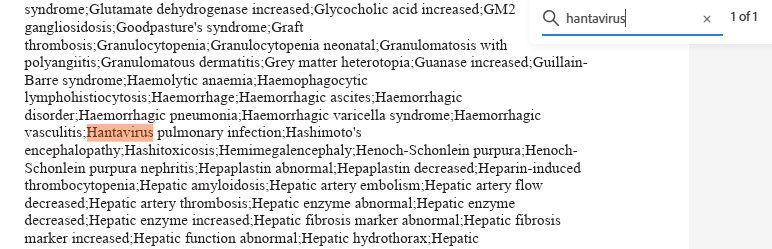
There’s no proof that a case of hantavirus even occurred after the Covid vaccine during the trials. The diagnosis is listed because it would fall under the general umbrella (higher level term, or HLT) of viral lower respiratory tract infections, and zero diagnoses (preferred terms, or PTs) were actually reported. This isn’t even a real saber-toothed tiger, it’s a picture book of what a saber-toothed tiger might look like if it attacked you. The list of actual PTs reported clearly shows no cases of Hantavirus. I screenshot the relevant table section from the document below.
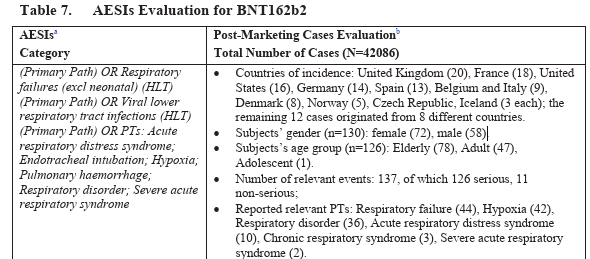
So, the list of “known side effects” of the vaccine isn’t even a list of side effects, it’s a list of diagnoses that were looked for, and Hantavirus was not found.
If you see posts about this, please feel free to educate the person posting about it about the difference between a side effect, an adverse event, and a shopping list.

